Leadership is not just about making the right calls, it is about owning them, even when the results are difficult or the reaction is not what you hoped for. Taking responsibility for your words and actions builds credibility, trust, and respect, even in challenging situations.
It is easy to claim ownership when the outcome is positive. The true test comes when the decision you made is met with resistance or the results are less than ideal. In those moments, some leaders may distance themselves from the choice or shift blame to others. Strong leaders do the opposite. They step forward and own their role.
(more…)When you think about the most innovative teams in the world – those that generate fresh ideas, solve complex problems, and pivot quickly in the face of challenges – there’s a common thread running through them: psychological safety. Harvard researcher Amy Edmondson defines psychological safety as the belief that you can speak up with questions, concerns, or mistakes without fear of punishment or humiliation. It’s not about being nice; it’s about creating the freedom to contribute without fear.
In workplaces where psychological safety is strong, employees are more likely to take risks, share bold ideas, and collaborate openly. In fact, Google’s landmark “Project Aristotle” study found that psychological safety was the number one predictor of team success. Without it, even the most talented individuals hold back, fearing judgment or negative consequences. The result? Innovation stalls, trust erodes, and organizations miss opportunities to thrive.
(more…)In a world where deadlines dominate and metrics measure our every move, it’s easy to overlook one of the most powerful tools a leader has – empathy. Not sympathy. Not kindness for kindness’ sake. But true, bone-deep understanding of what someone else is experiencing, feeling, or fearing. At its core, empathy is the currency of connection. And in leadership, that connection is gold.
Empathy, when practiced authentically, fuels trust. It creates the kind of psychological safety where people feel not just heard, but valued. This isn’t soft science – it’s strategy. Teams led by empathetic leaders outperform their peers because they are built on relationships, not just roles. In fact, understanding someone’s internal world opens doors to motivation, collaboration, and creative problem-solving that simply can’t be accessed through transactional leadership alone.
(more…)Addressing sensitive issues at work can be one of the most challenging parts of leadership. These moments require you to communicate with honesty so that the message is clear, but also with respect so that the relationship remains intact. Leaning too far in one direction can cause problems, too much honesty without care can feel harsh, and too much politeness without truth can lead to avoidance.
The key is to approach these conversations with the intent to solve a problem, not to win an argument. This means preparing both your message and your mindset. Clarity is important, but so is empathy. You want the other person to understand the issue and still feel valued and respected.
(more…)Many leaders put time and energy into preparing for a difficult conversation but overlook a critical final step – following up. Without follow-up, even the best intentions during the conversation can fade, leaving room for misunderstandings, uncertainty, or a return to old patterns.
Following up ensures that both parties are clear on what was discussed, what was decided, and what will happen next. It is an opportunity to reinforce agreements, answer lingering questions, and confirm that you are moving in the same direction. This step transforms a single conversation into meaningful, lasting progress.
(more…)Delegating a task is more than simply handing it off. It is an opportunity to develop someone’s skills, build their confidence, and prepare them for greater responsibility. That development does not happen automatically. It requires follow-up in the form of coaching and feedback after the task is complete.
Too often, leaders treat delegation as a one-time transaction. They assign the work, receive the results, and move on to the next priority. While this might get the task done, it misses a valuable chance to reinforce learning. Without feedback, the person has no way of knowing what worked well and what could be improved.
(more…)Staying fully present in a conversation is one of the most powerful skills a leader can develop. Yet even with the best intentions, it is easy to get distracted. Sometimes the cause is external, like noise or interruptions. Other times, the real distraction comes from within.
Internal distractions are often harder to spot. You might be replaying a difficult meeting in your head, worrying about a deadline, or feeling defensive about what is being said. These thoughts and emotions pull your attention away from the person speaking, even if you appear to be listening.
(more…)by Michelle Cummings
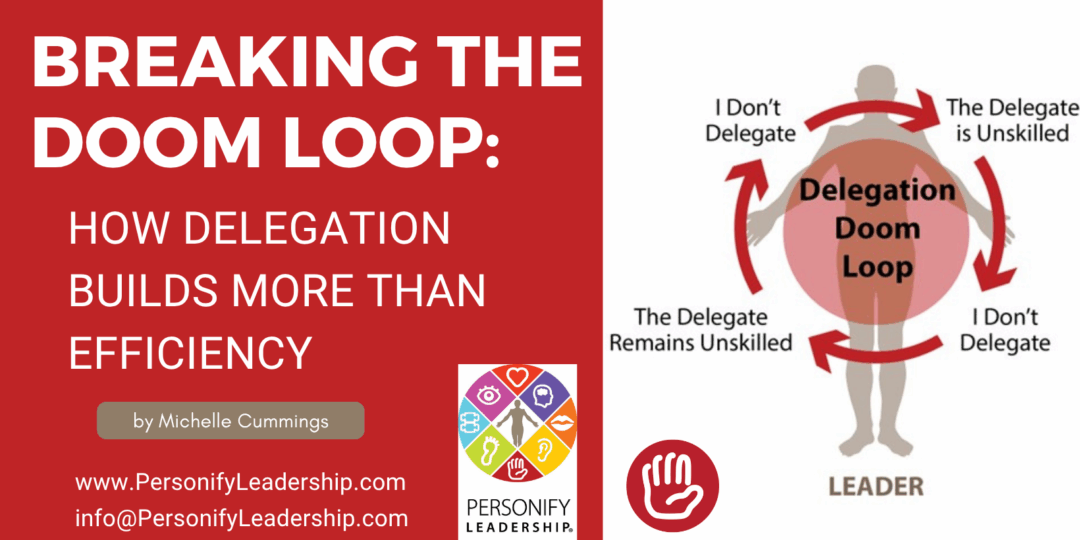
Delegation is often framed as a time-saver. And while it can free up your calendar, the deeper value lies elsewhere. Effective delegation is not about offloading work – it’s about developing people. It’s how leaders build capacity, trust, and long-term momentum.
But many leaders fall into what we call the Delegation Doom Loop. It starts with thinking, “It’s faster if I just do it myself.” That might be true in the short term. But over time, it creates a cycle where others never grow, and the leader stays buried in tasks that could be shared. The loop continues until burnout, resentment, or stalled growth forces a change.
(more…)Even the most skilled communicators have moments when their message does not land. You might be clear, confident, and well-prepared, but the other person’s expression or response tells you something is off. This is where flexibility becomes a leadership strength.
Sticking with the same approach when it is clearly not working can create frustration on both sides. The other person may shut down, get defensive, or become disengaged. You may feel the need to push harder, explain more, or retreat altogether. None of those options improves the connection.
(more…)

×
Tag: Intentional leadership






© 2012-2025 Personify Leadership. All Rights Reserved.
Recent Comments