Delegating a task is not just about assigning work, it is also about setting clear boundaries around decision-making and authority. Without this clarity, misunderstandings can arise, leading to frustration, delays, or outcomes that miss the mark. Our definition of Delegation is: Sharing Authority and Responsibility with another person. When this is communicated well, it’s a recipe for success. When this is left up to interpretation, it’s a recipe for disaster.
When leaders fail to define the level of authority, team members may either overstep and make choices they were not meant to make, or hesitate and delay progress because they are unsure what decisions are theirs to own. In both cases, the work suffers and trust can be strained.
(more…)Delegating a task is more than simply handing it off. It is an opportunity to develop someone’s skills, build their confidence, and prepare them for greater responsibility. That development does not happen automatically. It requires follow-up in the form of coaching and feedback after the task is complete.
Too often, leaders treat delegation as a one-time transaction. They assign the work, receive the results, and move on to the next priority. While this might get the task done, it misses a valuable chance to reinforce learning. Without feedback, the person has no way of knowing what worked well and what could be improved.
(more…)by Michelle Cummings
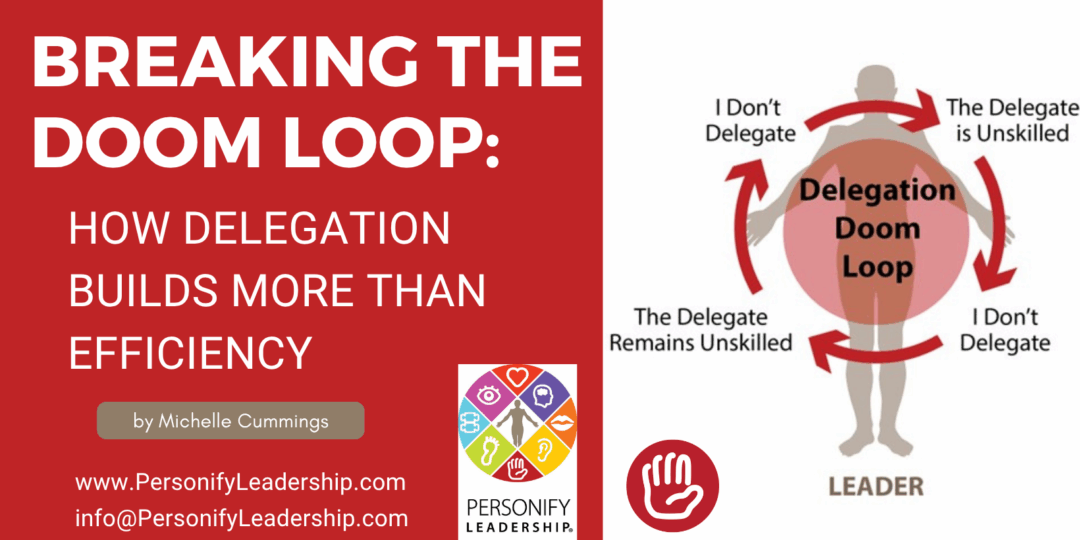
Delegation is often framed as a time-saver. And while it can free up your calendar, the deeper value lies elsewhere. Effective delegation is not about offloading work – it’s about developing people. It’s how leaders build capacity, trust, and long-term momentum.
But many leaders fall into what we call the Delegation Doom Loop. It starts with thinking, “It’s faster if I just do it myself.” That might be true in the short term. But over time, it creates a cycle where others never grow, and the leader stays buried in tasks that could be shared. The loop continues until burnout, resentment, or stalled growth forces a change.
(more…)One of the greatest challenges leaders face is not a lack of work to do, but rather the ability to decide which work is worth doing. With competing demands and endless to-do lists, the skill of distinguishing between high-value and low-value tasks becomes essential for effective leadership. The best leaders understand that not all tasks are created equal, and that their time, energy, and attention are finite resources.
High-value tasks are those that directly align with organizational goals, deliver measurable impact, and leverage the unique strengths of the leader. These tasks often support strategic priorities, drive revenue, improve efficiency, or build long-term capacity. In contrast, low-value tasks may keep a person busy but do little to advance broader objectives. While they may provide short-term satisfaction, they rarely produce meaningful results.
(more…)Delegation is a core leadership skill, but it is not a one-size-fits-all process. Each project and each person brings unique needs, skills, and challenges. Using the same delegation style in every situation can lead to misunderstandings, missed deadlines, or results that fall short of expectations.
Some tasks require a high level of structure and clear step-by-step instructions, especially when the work is new or complex. Others call for a more open-ended approach, allowing the person to bring creativity and ownership to the process. The right style depends on the nature of the work and the experience and confidence of the person doing it.
(more…)

×
Tag: Effective Delegation




© 2012-2025 Personify Leadership. All Rights Reserved.
Recent Comments